Industry
Education
Company
Fluency Academy
Team
Me (Lead Designer), Thiago Bisewski (Head of Design), Marcelo Lionço (Designer), Jullie Harten (PM) + Engineering Team

Lessons lived on Kajabi as an LMS, flashcard practice ran on Memhack, and conversation classes happened on Yowza. Each one did its job well, but each one also had its own login.
Students ended up juggling three separate accounts to do one thing: learn English. That setup quietly became one of the biggest sources of friction in the whole experience, and it was costing us in support time, trust, and momentum at exactly the moment students were trying to build a habit.
I led the design effort to fix this at the root, not by patching each product, but by building a single account layer that the whole ecosystem could plug into.
Constraints with validation
We grouped the work around three goals: unify identity, make connections visible, and reduce the number of paths that led to a support ticket.
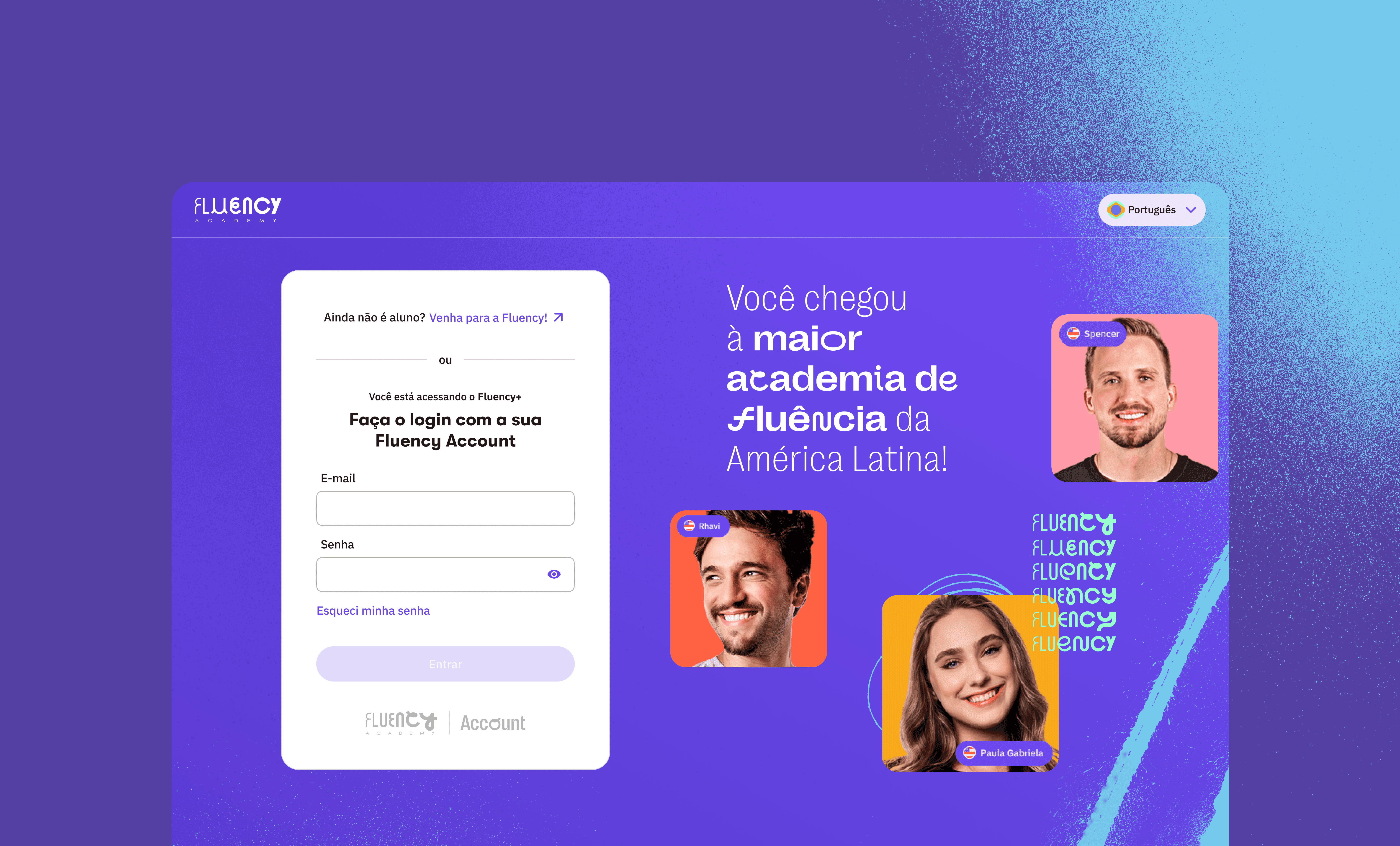
A dedicated Account product
We designed Fluency Account as a standalone experience with its own login, separate from any single product. This became the front door for the entire ecosystem and the home base for managing email, password, and connected products in one place.
A connection flow instead of a migration
Rather than forcing students to abandon existing logins, we built a guided flow to link an existing Kajabi, Memhack, or Yowza account to their new Fluency Account. The flow was designed to feel like adding a benefit, not fixing a problem.
One dashboard, full visibility
The dashboard surfaced every connected product with clear status indicators, so a student could see at a glance what was linked, what was not, and where to go next. This replaced what used to be three disconnected logins with one clear map of the ecosystem.


Key Decisions
Decision 1
Treat the account experience as its own product, not a feature bolted onto one of the existing tools. This meant a dedicated Account app that every other product would authenticate through.
Decision 2
Make linking existing accounts the default migration path instead of forcing a hard cutover. Students could connect their existing Kajabi, Memhack, and Yowza logins to one Fluency Account at their own pace.
Decision 3
Design the dashboard around a single question, "what can I access and how do I get there", rather than around account settings. Connections to other products needed to feel like the main event, not a buried menu.


Multi-brand approach
The project was implemented in a way that adopts the identity of each brand within the ecosystem, ensuring scalability and the use of style tokens.